

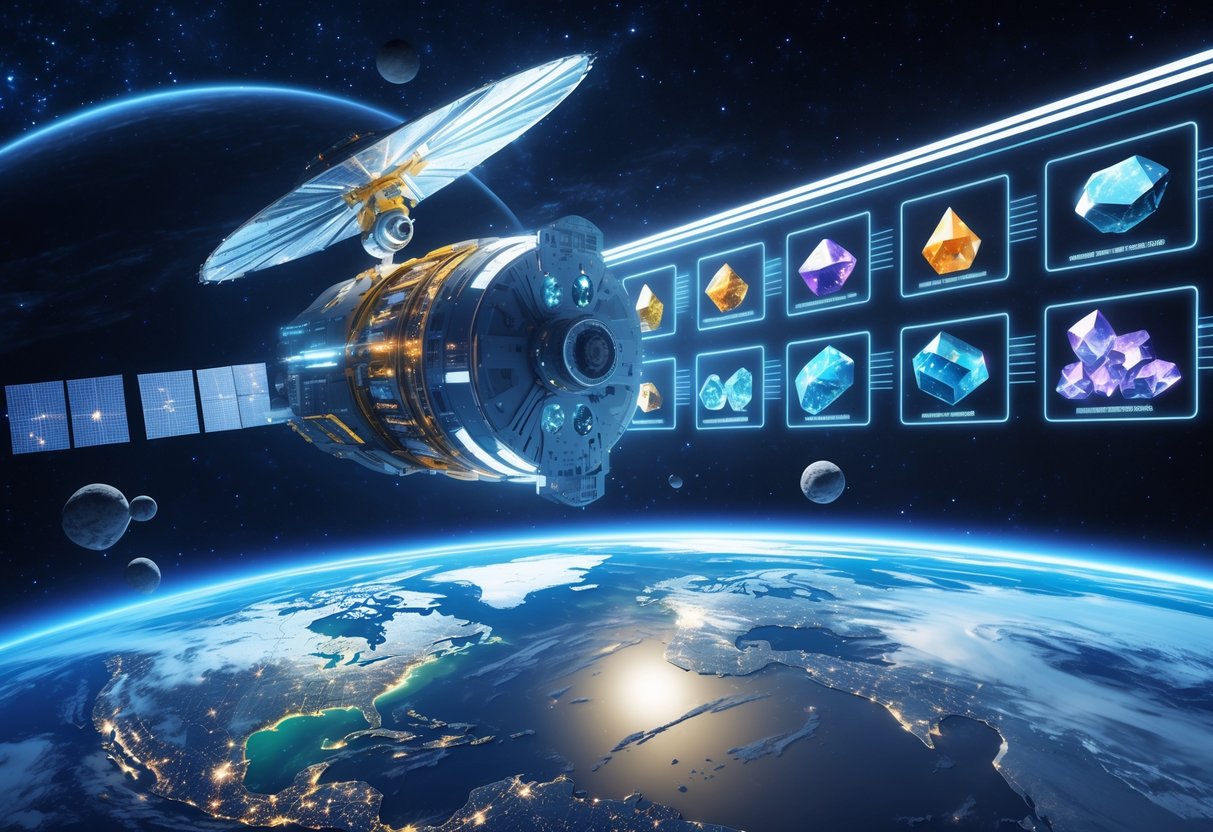
Space commodities are materials and resources that people extract, process, and trade within the space economy. They’re different from Earth-based resources because they’re harder to access, costlier to move, and fall under different rules.
These resources basically form the backbone of commercial space operations. Standardized trading makes their exchange possible.
Space commodities don’t play by the same rules as Earth materials. Transportation costs drive prices way up—sometimes, getting the stuff there costs way more than the stuff itself.
Where a commodity sits in space completely changes its value. Water from lunar ice is way cheaper to send to Mars than shipping water from Earth. So, the same material can have wildly different prices depending on where it is in orbit.
Regulations for space commodities are still kind of a mess. International space law leaves a lot up in the air, especially around property rights and extraction. The Outer Space Treaty of 1967 doesn’t really clear up who owns what, which makes pricing and investing a bit of a gamble.
Storing and processing these resources takes special facilities. They have to handle vacuum and radiation, which isn’t cheap or easy compared to what we do on Earth.
Water stands out as the most valuable space commodity. Spacecraft rely on water for shielding, life support, and making fuel by splitting it into hydrogen and oxygen. The Moon’s polar regions have a lot of water ice, and companies are eyeing those deposits.
Asteroids hold rare earth elements in concentrations you just don’t see on Earth. One metallic asteroid can have more platinum than all of Earth’s mines combined. These materials are crucial for electronics and building propulsion systems.
Lunar regolith contains helium-3, an isotope the solar wind delivered over billions of years. If fusion reactors become practical, helium-3 could be a game-changer, but we’re not there yet.
Structural materials like iron, aluminum, and titanium make in-space manufacturing possible. Processing them in zero gravity means we don’t have to launch as much from Earth.
Standardization turns resources into tradable goods. Space commodities need strict quality specs—purity, contamination, physical properties. Even water has to meet requirements for chemical makeup, temperature, and packaging.
Delivery standards matter too. They set the rules for containers, drop-off points, and how to hand over materials. This way, buyers don’t have to figure out new logistics every time.
Futures contracts let companies plan ahead. They can lock in water deliveries for Mars or metals for satellites before mining even starts. This sort of forward contracting helps cut supply chain risks in this new economy.
Exchange platforms give everyone a way to manage risk and discover prices, just like Earth’s commodity markets. Traders can hedge against swings and rely on standard deals instead of haggling every time.

Water is the backbone of space commerce. Metals and rare elements are valuable for manufacturing. Regolith is essential for building space infrastructure.
Water is hands-down the most important resource for space business. The Moon’s poles hide billions of tons of water ice in shadowed craters. Asteroids have even more water than Earth does.
By splitting water into hydrogen and oxygen, we get rocket fuel. Liquid hydrogen and liquid oxygen power most modern rockets, including the Space Shuttle and Artemis missions.
Space-based refueling stations could make launching fuel from Earth almost obsolete. This could cut deep space mission costs by as much as 80%. SpaceX and Blue Origin have both talked about orbital fuel depots.
Mining on the Moon could produce thousands of tons of water each year. Every ton of water yields 800 kilograms of rocket fuel. Missions to Mars, asteroids, and beyond could launch without needing Earth-supplied fuel.
Asteroids are loaded with precious metals—sometimes more than Earth’s entire crust. One metallic asteroid can be worth trillions in platinum alone. These resources include gold, silver, platinum, and rare earths.
Platinum group metals are vital for electronics, catalysts, and fuel cells. Most of Earth’s platinum comes from just a couple of places. Space mining could make the supply chain more stable and prices less crazy.
Iron and nickel from asteroids are perfect for building stuff in space. They go into space stations, solar panels, and spacecraft hulls. Manufacturing up there means we don’t have to haul all that metal out of Earth’s gravity.
Rare earths power everything from smartphones to satellites. Right now, China controls most of the market. Space mining could shake that up and offer alternatives.
Processing facilities in orbit can turn raw metals into finished goods. Zero gravity opens up manufacturing tricks you just can’t pull off on Earth. These space factories could supply both space missions and even Earth, eventually.
Lunar regolith covers the Moon in a thick layer. It’s packed with silicon, aluminum, iron, and titanium. People use it as the main building material for lunar bases and habitats.
3D printing technology can turn regolith into concrete-like structures. NASA’s tests show lunar concrete can be stronger than a lot of what we use on Earth. This tech makes landing pads, roads, and building foundations right on the Moon.
Solar panels and glass need silicon, which regolith has in spades. The Moon’s surface is about 20% silicon dioxide, so there’s no shortage. Space-based solar arrays could power lunar operations and maybe even beam energy back to Earth.
Regolith also acts as radiation shielding. Thick layers block cosmic rays and solar storms. Digging habitats underground or piling regolith on top keeps astronauts and tourists safer.
Oxygen extraction from regolith supports life support systems. Moon dirt is about 40% oxygen by weight. This oxygen can keep people alive and fuel rockets heading home.
The growing space economy needs real trading platforms where people can buy and sell resources from space. These exchanges have to tackle the weird challenges of space while giving commercial ventures some much-needed stability.
The Space Commodities Exchange borrows from proven trading models, but tweaks them for space. They use tech and ideas from places like the London Metals Exchange and Chicago Mercantile Exchange.
Orbital facilities store actual commodity stockpiles to back up every transaction. This way, trades reflect real resources—not just paper promises.
Key Infrastructure Components:
The exchange connects lunar water miners, asteroid prospectors, manufacturers, and satellite operators. Standard contracts make things simpler for everyone.
Space tugs, built by aerospace companies, work directly with SCX. They move commodities between storage and customers, following exchange rules.
SCX uses basic supply and demand to set prices for space commodities. Their regulated market aims to keep price swings in check and make things transparent for buyers and sellers.
Futures markets let companies lock in prices for deliveries at specific times and places. This helps space businesses budget and avoid nasty surprises.
Risk Mitigation Features:
Speculators who understand space markets add liquidity. Their trading helps set fair prices based on real conditions, not just guesswork.
The exchange keeps things transparent with real-time reports of trades, inventory, and deliveries. This info helps everyone make better decisions about where to send resources.
Orbital storage is at the heart of settling trades. These facilities have to protect different materials and only let authorized people in.
Settlement happens when the exchange transfers the actual commodity from storage to the buyer’s chosen spot. Advanced tracking follows every step, so mistakes and disputes stay rare.
Settlement Infrastructure:
The exchange works with spacecraft operators to handle deliveries. They schedule transports, confirm cargo details, and track shipments until they arrive.
Payments tie into Earth’s financial networks, but they also have to deal with space communication delays. Smart contracts kick in automatically when deliveries are confirmed, cutting down on paperwork.
Space resources need special extraction, processing, and logistics systems before they become usable commodities. These systems all connect and power the new space economy.
Robotic systems lead space mining. Companies like AstroForge send small spacecraft with drills to latch onto asteroids and extract metals like platinum and gold.
Optical mining tech uses focused sunlight to heat up asteroid surfaces, releasing trapped materials. TransAstra’s Omnivore spacecraft does this by aiming solar energy at rocks to extract water.
Lunar extraction targets ice in the Moon’s shadowed craters. Heated drills bore into regolith and collect water vapor for fuel or life support.
Asteroid mining robots work in microgravity, using special anchors. The robots drill in and stay put with magnetic or mechanical grips so they don’t drift away.
Space missions need dedicated cargo ships to move mined materials. Fleets of small spacecraft shuttle resources from asteroids to stations or lunar bases.
Storage is tricky in space. Extreme temperatures and radiation can ruin materials, so specialized containers protect things like water ice during long trips.
Orbital depots act as pit stops for commodities before they head to Earth or elsewhere. These facilities offer temporary storage and some basic processing.
Transportation costs often decide if a mining operation makes sense. Companies focus on high-value stuff that can pay for all the shipping and storage.
ISRU systems process materials right where they’re mined. This cuts down on how much needs to be shipped. They turn lunar regolith into building materials or pull water from asteroid samples for immediate use.
Modular processing units hook up with mining robots to create full-blown extraction facilities. Interlune’s ISRU units heat regolith to separate water vapor and metals for construction.
Mobile refineries can travel between sites and process materials on the spot. This means less need for permanent infrastructure but still plenty of processing power.
Automated systems run most of the show, so humans don’t have to oversee everything. Advanced sensors and controls manage extraction and refining, making it all a lot more doable and cost-effective.
Three main orbital zones make up today’s space commerce backbone. Low Earth Orbit is the hub for satellite servicing and cargo transfers. Geostationary Earth Orbit handles communication satellites and deep space mission staging. Cislunar space ties Earth operations to lunar resources.
LEO stands out as the most accessible trading zone in the space economy. Spacecraft reach this region using much less fuel than they need for higher orbits.
Commercial space stations in LEO provide permanent infrastructure for commodity storage and transfer. Companies like Axiom Space are attaching new facilities to existing stations, aiming to grow trading capacity.
Key LEO commodities include:
The International Space Station shows how LEO supports regular cargo deliveries. Now, private companies run scheduled supply flights instead of just one-off missions.
LEO sits close to Earth, making it perfect for quick turnaround operations. Spacecraft drop off commodities and return in days, not the weeks or months that higher orbits demand.
Most satellite servicing happens in LEO because operators can extend missions by refueling. This drives steady demand for propellant and replacement parts.
GEO sits about 22,236 miles above Earth’s equator and matches the planet’s rotation. That spot makes GEO prime real estate for communication networks and Earth observation.
GEO acts as a staging area for deep space missions. Spacecraft stop here to refuel and resupply before heading to the Moon or asteroids.
Communication satellites really dominate GEO commerce. These satellites need regular maintenance and fuel to keep running for 15-20 years.
The high altitude in GEO brings tough logistics. Cargo travels much farther than in LEO, so transportation costs jump up.
Major GEO commodities:
Companies are building specialized tugs to move commodities between GEO satellites. These vehicles help satellites reposition without hauling tons of extra fuel.
GEO’s fixed position relative to Earth makes it a great spot for permanent infrastructure. Someday, space docks here could hold big reserves of fuel and supplies for distribution deeper into the solar system.
Cislunar space stretches between Earth and the Moon, including the five Lagrange points where gravity balances out. This region connects operations on Earth with activities on the lunar surface.
The Cislunar Commodities Exchange helps trade flow between Earth, orbital facilities, and Moon bases. Commodities move both ways—lunar mining exports materials, while equipment and supplies go in.
L1 Lagrange point acts as a key transfer hub. Spacecraft from Earth reach L1 efficiently, then redistribute cargo to lunar operations or farther out.
Water from lunar ice becomes a valuable cislunar commodity. When split into hydrogen and oxygen, it turns into rocket fuel for spacecraft across the region.
Mining on the Moon exports rare earth metals and helium-3 to facilities in Earth orbit. These materials support manufacturing in space and clean energy back home.
The Strategic Space Commodities Reserve would have the US government buy set amounts of materials at specific cislunar locations. That creates guaranteed markets for private companies working on space mining.
Cislunar space finally enables true space-to-space commerce, not just Earth-to-space deliveries. Permanent settlements and industrial sites create steady demand for all kinds of commodities and services.
The space commodities market brings together all sorts of players, from private companies building asteroid mining tech to government agencies setting up regulatory frameworks.
Space tourism companies are driving new demand for space-based resources. Meanwhile, traditional aerospace firms are reworking their business models to support commercial space operations.
Private companies push most of the innovation in space commodities these days. SpaceX changed the game on launch costs, making space resource extraction actually make sense financially. Blue Origin is all-in on lunar ice mining to support its space tourism plans.
Asteroid mining companies like Planetary Resources and Deep Space Industries started the push to extract water, platinum, and rare earths from near-Earth asteroids. Their research lives on through partnerships with bigger aerospace firms.
Traditional defense contractors are jumping into commercial markets too. Northrop Grumman and Lockheed Martin now develop extraction equipment and processing facilities for space operations. These companies have decades of spacecraft know-how they can apply to commodities ventures.
Satellite manufacturers design special equipment for resource prospecting missions. Ball Aerospace builds sensors to spot valuable asteroid compositions from Earth orbit. Small satellite companies make resource surveys much more affordable.
NASA takes the lead on government involvement with its Commercial Lunar Payload Services program. The agency buys lunar ice and regolith samples from private companies, creating the first real space commodities market.
The Space Force sets up space traffic management protocols for mining operations. Military satellites keep an eye on asteroid mining to prevent conflicts and keep things safe near Earth.
International cooperation shapes the rules. The International Telecommunication Union coordinates frequencies for mining communications. The United Nations Office for Outer Space Affairs drafts guidelines for resource extraction.
Space agencies in Europe, Japan, and elsewhere invest in resource utilization tech. ESA’s lunar village idea relies on extracting water and oxygen from moon rocks. These partnerships build multinational supply chains for space commodities.
Space tourism companies are quickly becoming major users of space resources. Virgin Galactic needs specialized fuels for suborbital flights—maybe produced in space someday, not launched from Earth.
Blue Origin’s lunar lander operations depend on water ice for fuel. The company wants mining facilities that support both cargo missions and space tourism flights to lunar orbit.
SpaceX’s Mars colonization goals ramp up demand for in-space resource use. Starship missions need methane fuel, which crews could make from Martian atmosphere and subsurface ice.
Commercial space stations run by Axiom Space and others need water, oxygen, and building materials. These stations serve tourists and create steady demand for extracted resources.
Companies building space hotels need bulk materials for construction and operation. Tourism infrastructure might become the first big market for space commodities outside government contracts.

The legal landscape for space commodities runs through a complicated web of international treaties from 1967, national legislation by spacefaring countries, and shifting ethical standards for extracting resources off-Earth. These frameworks directly affect how companies can legally extract, own, and sell materials from asteroids, the Moon, and other bodies.
The Outer Space Treaty of 1967 is the bedrock of space law. It says outer space belongs to all humanity and bans national appropriation of celestial bodies. Over 100 countries, including the US, have signed on, so it’s the basic rulebook for space activities.
Article VI of the treaty puts governments in charge of authorizing and supervising non-governmental space activities. Private companies have to get licenses from their home countries before they can mine in space.
The Moon Agreement of 1979 tried to take things further, calling celestial resources the “common heritage of mankind.” But the US, Russia, and China never signed it, so it doesn’t hold much weight in practice.
Space law keeps evolving as the United Nations Committee on the Peaceful Uses of Outer Space tries to fill gaps in current treaties. The committee drafts guidelines for sustainability and responsible behavior, though these are just recommendations—not enforceable laws.
The non-appropriation rule in the Outer Space Treaty leaves big questions about resource ownership. Nations can’t claim territory in space, but the treaty doesn’t say if you can own what you extract.
United States legislation offers the clearest path for commercial space mining. The Commercial Space Launch Competitiveness Act of 2015 gives American companies the rights to own and sell resources they extract. The law spells it out: any asteroid resources a US entity gets belong to that entity.
Luxembourg passed its own Space Resources Act in 2017, making itself Europe’s go-to place for space mining ventures. The country hands out licenses for resource extraction and guarantees ownership rights over what companies harvest.
These national laws create a patchwork of rules that might clash with international interpretations. Companies have to navigate domestic licensing and potential disputes over territorial claims as space mining ramps up.
Space mining brings up real worries about damaging pristine celestial environments. There aren’t any international environmental standards for space activities, so companies basically self-regulate their impact on asteroids and other bodies.
Sustainable mining practices mean companies should minimize surface disruption and protect areas with scientific value. Developers need to think about how their operations affect the long-term usability of resources and keep space environments intact.
Ethical questions swirl around fair access to space resources. Some critics say space mining could let a few rich countries and corporations grab all the benefits, which goes against the idea that space is for everyone.
The global community still debates whether space mining needs an international regulatory authority—something like the International Seabed Authority for ocean mining. Such a body could make sure space-derived benefits get shared fairly and prevent monopolies on the best resources.
The space economy boomed in 2024, hitting $613 billion, with commercial activities driving 78% of the growth. Space commodities add value across a bunch of sectors, from satellite communications to Earth observation services.
The global space economy posted 7.8% year-over-year growth in 2024, setting new records for commercial activity. This surge shows how space-based services are maturing and impacting daily life and business.
Commercial space now makes up $481 billion of the total market. Companies like SpaceX, Blue Origin, and Virgin Galactic have changed space access with reusable launch systems. These tech advances cut costs and boost launch frequency.
Government spending added $132 billion to space activities in 2024. The US alone poured $77 billion into national security and civil space programs, supporting both military and scientific research.
Space launch activity exploded in early 2025. Between January and June, there was an orbital launch every 28 hours. SpaceX handled 81 launches, more than half of the world’s 149 total in that stretch.
Industry forecasts say the space economy could reach $1 trillion by 2032. That growth comes from expanding commercial markets in communications and Earth observation satellites.
Satellite broadband drives big investments. SpaceX’s Starlink faces more competition from Amazon’s Kuiper constellation and Eutelsat’s OneWeb. These mega-constellations need thousands of satellites, creating steady demand for launch services.
Earth observation satellites bring in real revenue through disaster response and predictive analytics. Companies sell this data to agriculture, insurance, and city planning sectors. The quality and frequency of satellite imagery keeps getting better.
Private investment speeds up new space commodities development. Asteroid mining companies attract funding, even with long timelines. Space manufacturing offers chances to make materials you just can’t produce on Earth.
Space commodities power entire industries that depend on satellite services. GPS supports logistics, agriculture, and navigation—worth hundreds of billions every year.
Communications satellites bring internet to remote areas. These services connect isolated communities to global markets. Telecom companies spend big on satellite capacity to meet rising bandwidth needs.
Weather forecasting now relies on space-based sensors for accurate predictions. Farmers use satellite data to monitor crops and boost yields. Insurance companies build space-derived info into risk models.
Manufacturing benefits from space-based Earth observation too. Mining companies spot resource deposits with satellite imagery. Construction firms track infrastructure projects using regular satellite updates. All these uses keep the demand for space-derived information services going strong.
Advanced digital systems and blockchain networks now form the backbone of transparent space resource trading.
These tools let people track materials in real-time, all the way from asteroid mines to orbital factories.
Blockchain technology is shaking up how space commodities exchanges work. Every transaction gets a permanent record, and smart contracts can execute trades automatically when certain conditions—like mining quotas or delivery schedules—are met.
Digital ledgers keep tabs on who owns what, from the moment of extraction to final use. This approach helps prevent fights over mining rights and commodity ownership, especially when multiple countries and companies get involved.
Each block in the chain holds verified info about quality, quantity, and location. That’s a lot of detail, and it’s all out in the open.
Space-based blockchain networks don’t rely on Earth systems. This setup protects trading data from interference on the ground and adds some much-needed redundancy.
Multiple satellite nodes verify transactions, so the system doesn’t fall apart if there’s no ground-based internet.
Satellite networks keep an eye on commodity movements throughout the solar system. They track cargo ships as they move between mining sites, factories, and customers.
GPS-style tech can pinpoint exactly where valuable materials are during transit. It’s honestly impressive how precise they’ve gotten.
Market data systems scoop up pricing info from different trading platforms. Automated algorithms then analyze supply and demand patterns for metals, water, and energy.
Traders can use this data to make smarter decisions about future prices, though nothing’s ever certain.
Advanced sensors measure commodity quality right at the source. These devices test for purity, structural strength, and chemical makeup.
Trading platforms pull this data in directly, so buyers know exactly what they’re getting before they commit.

Space commodities markets deal with some pretty wild disruptions, nothing like what we see with Earth-based trading.
Transportation delays and tech failures expose supply chain vulnerabilities. The newness of these markets also creates intense price swings that keep traders on their toes.
Space-based supply chains face constraints that Earth markets just don’t.
A single rocket failure can set deliveries back by months or even years, and the whole network feels the impact.
Weather at launch sites often pushes back missions carrying critical materials. SpaceX and Blue Origin deal with these kinds of delays all the time, which throws off cargo schedules for the International Space Station and commercial satellites.
Transportation bottlenecks are a huge risk. Launch windows to certain orbits are limited, so missing one can push deliveries way out, sometimes into a completely different mission cycle.
Inventory shortages pop up fast and ripple through manufacturing and research in space.
Technical failures make things worse. If a spacecraft hits a snag during transit, cargo might get lost or show up damaged.
Insurance markets try to price these risks, but the financial pain still hits end users who need steady material flows.
Geopolitical tensions pile on even more uncertainty. International space partnerships can break down during conflicts, cutting off access to launch services or orbital facilities that the market depends on.
Space commodity prices swing wildly thanks to supply constraints and a small pool of market players.
Unlike Earth, where you’ve got tons of suppliers and trading history, space markets often rely on a single provider for key materials or services.
Launch costs have a direct impact on commodity prices. When SpaceX drops Falcon 9 launch prices, it changes the economics for every operation in space.
These changes ripple through the market in just weeks, sometimes catching traders off guard.
Demand swings from government contracts add more volatility. If NASA or the Space Force shifts its mission plans, that can soak up a huge chunk of available supply, leaving commercial buyers scrambling—and paying a premium.
There’s not much storage capacity in orbit, so excess inventory can’t cushion price shocks like warehouses do on Earth. That makes market reactions even more dramatic.
New players face steep barriers to entry, mostly because space operations cost a fortune. Only a handful of companies can compete, so existing suppliers hold a lot of power.
A space commodities exchange could totally change how companies trade resources beyond Earth. Integration with existing financial markets and the rise of new commodity types will probably drive a lot of growth over the next decade.
Space commodities exchanges will link up directly with Earth-based trading platforms. Major exchanges like the Chicago Mercantile Exchange already handle all sorts of complex futures contracts for agriculture and energy.
The same kind of trading will apply to space resources. Companies will be able to lock in prices for asteroid water or Moon-mined rare earth metals.
That kind of predictability helps with mission planning and manufacturing.
Risk management becomes a big deal since space ventures require massive upfront investment. A commodities exchange lets buyers hedge against price swings and supply hiccups. Sellers can lock in revenue before they even launch extraction missions.
Financial institutions will jump in with new investment products tied to space commodities. Pension funds and hedge funds can diversify with space assets, and insurance companies will offer coverage for commodity deliveries between orbital facilities.
The exchange will standardize contracts for space-to-space transactions. A satellite builder in low Earth orbit could buy fuel from a depot in geostationary orbit, using familiar trading rules.
Space will see the rise of commodities that don’t even exist on Earth. Orbital slots are turning into tradeable assets as satellite constellations grow.
Premium positions in geostationary orbit fetch higher prices than less desirable spots.
Zero-gravity manufacturing opens up new possibilities. Companies will trade contracts for things like protein crystals, fiber optics, and pharmaceuticals that need microgravity.
Transportation between orbital zones is evolving into a commodity itself. Trading a ton of cargo from low Earth orbit to lunar orbit could become as routine as shipping containers on Earth.
Waste processing and recycling services will become valuable as space operations expand. Turning debris into raw materials or managing station waste will be something companies can buy and sell.
Energy storage and distribution will create new trading categories. Solar power collected in space and beamed to lunar bases or factories becomes a commodity with its own supply and demand cycles.
Life support commodities—air, water, food production—will be critical for crewed missions. These will become tradeable elements, too.

Extracting space commodities comes with tricky technical challenges and a whole mess of regulatory questions. Mining valuable stuff from celestial bodies needs new methods and some creative legal thinking.
Platinum group metals top the list for asteroid mining. Just one metallic asteroid might hold more platinum than humanity has ever dug up on Earth.
These metals are crucial for electronics, medical tech, and cars.
Asteroids also hold rare earth elements like neodymium, europium, and terbium. These power everything from smartphone screens to wind turbines and EV batteries.
Since Earth’s supplies are limited, asteroid sources become incredibly valuable.
Water ice is another big one. It serves as rocket fuel and life support. Split water into hydrogen and oxygen and you get propellant for spacecraft—no need to haul fuel up from Earth.
Gold, silver, and other precious metals show up in asteroid cores, too. Some asteroids have gold concentrations that put Earth’s richest mines to shame.
The Outer Space Treaty of 1967 says no country can claim a celestial body. So, nobody can own an asteroid or a patch of the Moon.
That leaves legal uncertainty for companies hoping to mine in space.
The Moon Agreement of 1984 calls space resources the “common heritage of mankind.” Only 18 countries signed it, and the big space powers—like the US, Russia, and China—didn’t.
Some countries have passed their own laws to clarify things. The US Commercial Space Launch Competitiveness Act lets American companies keep what they extract. Luxembourg has similar rules to encourage space mining.
International frameworks for space commodities markets are still a work in progress. Legal experts debate whether current treaties even cover private mining.
New agreements might be needed as commercial space mining takes off.
Robotic mining systems are taking the lead. Automated drills and excavators can work in a vacuum for long stretches, controlled from Earth—even with communication delays.
Solar concentrators use focused sunlight to melt asteroid material. No chemicals needed, just pure solar energy, which gets hot enough for metal extraction.
Magnetic separation sorts out valuable metals from the rest. Different minerals react to magnetic fields in their own way, and this process works pretty well in zero gravity.
In-situ resource utilization turns local materials into useful products. Building processing facilities in space means you don’t have to ship everything from Earth.
These systems can make fuel, construction materials, and life support supplies right where they’re needed.
Private companies are pushing space mining tech forward. Firms like Planetary Resources and Deep Space Industries started asteroid prospecting years ago, attracting investment for space resource projects.
Commercial partnerships with space agencies speed up development. NASA works with private companies through tech development contracts, combining government know-how with private innovation.
Venture capital backs early-stage space mining companies, betting on future returns from resources in space.
Private funding allows for rapid prototyping and tech demos.
Space transportation companies provide the backbone. SpaceX, Blue Origin, and others have cut launch costs, making space mining more realistic.
Space commodities exchanges will handle trading of extracted materials. These markets need standardized contracts and regulated platforms, so buyers and sellers can count on transparent pricing.
Transporting materials from space to Earth requires specialized reentry vehicles to keep cargo safe during descent.
Landing sites will need facilities for processing incoming commodities.
Supply chain management systems will track materials from extraction to delivery. Blockchain technology could verify origin and chain of custody.
Quality control ensures space-derived materials meet Earth’s standards.
Integrating space materials into existing commodity markets won’t be easy. If large amounts hit the market at once, Earth-based mining could take a hit.
A gradual rollout might help soften the impact.
Mining in space can create a lot of debris, and that debris threatens satellites and spacecraft already out there. When people set up mining operations, they might end up adding even more junk into orbit.
Engineers need to build solid collision avoidance systems to keep both mining gear and space infrastructure safe. It’s a challenge that probably won’t get easier as more players join the game.
There’s also the question of preserving celestial bodies. Large-scale extraction could easily damage or even wipe out objects that hold scientific value. Some asteroids—who knows which ones—might contain clues about how our solar system formed.
If we start using resources from space, maybe we’ll ease the environmental burden on Earth. Mining out there means we don’t have to dig up as much down here.
That could help protect Earth’s ecosystems while still meeting our hunger for resources. It’s not a perfect solution, but it’s something.
People also worry about contamination. Anything brought back from space needs strict quarantine. And if we send microbes out there by accident, we could mess with any life that might exist on those distant worlds.
